

“The guest list is finalized.”
Or at least, that’s what everyone says a few hours before the event begins. But managing last-minute guest changes is often a real challenge for any host.
In reality, experienced event teams know that managing last-minute guest changes has become one of the most challenging aspects of modern event operations. Guest management rarely stops when invitations are sent or seating plans are approved.
In high-profile events especially, the final hours before doors open are often when the most sensitive operational changes happen.
- A VIP guest confirms attendance unexpectedly
- A PR team requests a seating adjustment moments before guest arrival
- An executive decides to bring additional attendees
- A backstage access permission suddenly needs to be updated.
And all of this can happen while welcoming teams are already preparing for guest arrival. This is one of the least visible — but most critical — aspects of live event operations. Because the challenge is not simply changing a name inside a spreadsheet.
The real challenge is ensuring that every operational layer of the event remains perfectly synchronized while changes continue happening in real time.
Last-Minute Guest Changes Affect More Than Most People Realize
Outside the industry, people often underestimate how interconnected modern event operations have become.
Managing last-minute guest changes is rarely as simple as updating a single piece of information. A single guest update can impact multiple teams simultaneously.
The update itself may seem minor — a new confirmation, an added +1, a seating change, or an access adjustment — but its operational consequences often extend far beyond a single team.
It may affect:
- seating charts
- table capacities
- check-in operations
- hostess instructions
- QR code validation
- digital tickets
- backstage permissions
- hospitality workflows
- transportation coordination
- reporting and attendance tracking.
During high-pressure events, these updates rarely happen in isolation. More often, they occur simultaneously, creating a chain of operational consequences.
- One modification triggers another.
- A new confirmation creates a seating adjustment.
- A seating adjustment creates a hospitality update.
- A hospitality update requires a communication change.
- A communication change impacts welcoming operations.
The closer the event gets to opening time, the more operational pressure increases. This is where fragmented workflows start becoming dangerous.
Where Traditional Event Workflows Begin to Collapse
Many event teams still rely on operational methods that become extremely fragile under pressure.
Typically, the workflow starts reasonably well.
- There is a master spreadsheet.
- Several exported PDFs.
- Different WhatsApp groups.
- Separate versions for PR, hospitality, production, and welcoming teams.
At first, this can feel manageable. But as the pace accelerates, synchronization becomes increasingly difficult.
- One team updates a spreadsheet locally.
- Another team continues using an outdated PDF.
- Someone shares a screenshot that becomes obsolete fifteen minutes later.
- A staff member receives a verbal instruction that never reaches the check-in team.
Eventually, nobody is completely certain which version is the correct one anymore. This is one of the biggest operational risks during live events: not the absence of information, but the existence of multiple conflicting versions of information.
And unlike many other industries, event operations leave very little room for recovery once guests begin arriving.
The challenge is rarely a lack of information. It is ensuring that every team is working from the same information at the same time.
The consequences become visible immediately:
- A guest arrives at the entrance and the welcoming team sees outdated information.
- Hospitality staff work with old access permissions.
- VIP movements are not synchronized properly.
- Teams start improvising under pressure.
The guest may never know exactly what caused the issue. But they immediately perceive friction. And guest experience is often defined precisely by the absence of friction.
Why Excel Alone Struggles During Live Event Operations
Spreadsheets remain incredibly useful operational tools. Most event teams will continue using Excel in some capacity for years. The problem is not the spreadsheet itself.
The problem appears when spreadsheets become the operational center of a live event environment involving multiple teams, devices, access levels, and real-time updates.
Spreadsheets were not originally designed to function as synchronized operational systems during high-pressure live experiences. Especially when:
- multiple stakeholders edit simultaneously
- guest statuses evolve continuously
- seating changes happen dynamically
- welcoming teams work on mobile devices
- QR validation needs live updates
- hospitality permissions change in real time.
This is why many event teams eventually discover that operational complexity grows exponentially as events become more sophisticated.
The issue is rarely the number of guests alone. A 150-person relationship-driven dinner can easily become more operationally complex than a 1000-person conference. Because relationship dynamics, protocol, visibility, and guest positioning become central to the event experience.
What Structured Event Teams Do Differently Today
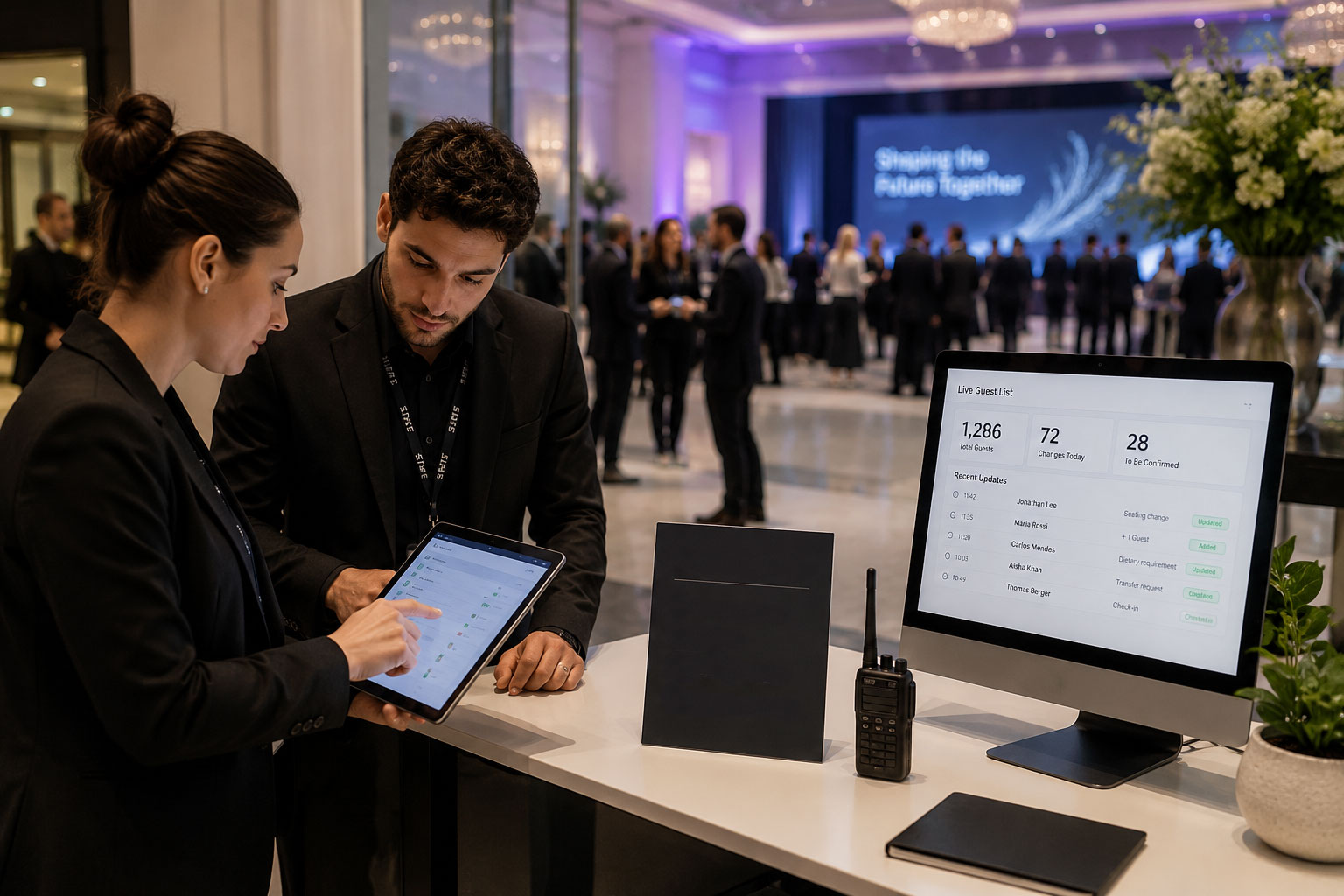
Over the last few years, many experienced event teams have shifted away from fragmented operational workflows toward more centralized systems. Increasingly, this means relying on event management platforms designed to keep guest data, seating operations, check-in workflows, and hospitality teams synchronized in real time.
Not necessarily because they wanted “new technology,” but because keeping teams aligned across disconnected tools became increasingly difficult once events reached a certain level of complexity.
Today, the most structured teams increasingly operate with workflows where:
- guest data remains centralized
- seating updates synchronize instantly
- check-in teams work from live information
- hospitality staff access updated guest statuses
- QR codes and tickets remain connected to the latest attendee data
- all operational teams share the same source of truth, instead of depending on exported spreadsheets, screenshots, or disconnected communication threads.
This changes how teams approach managing last-minute guest changes. Instead of relying on manual updates and fragmented communication, event teams can operate from a shared, real-time view of the event.
Every update is synchronized across the teams involved, allowing everyone to work from the same information at the same time.
And perhaps most importantly, operational managers maintain a clear and up-to-date view of the event. Instead of reacting blindly through messaging threads and fragmented updates, they can understand what is happening in real time.
Operational Precision Is Part of the Guest Experience
One of the most interesting aspects of managing high-value events is that guests rarely notice operational excellence directly. They simply experience the result.
- A smooth arrival.
- A correct greeting.
- A seamless seating experience.
- Fast access validation.
- Well-coordinated hospitality interactions.
- Staff members who appear informed and aligned.
When operations run smoothly, the event feels effortless. Yet behind that effortless experience, there is almost always an enormous amount of operational synchronization, spanning everything from invitations and RSVPs to guest arrival and on-site hospitality.
This is why modern event operations increasingly depend not only on creativity and guest experience design, but also on the ability to maintain operational consistency while the event environment continues evolving minute by minute.
This operational approach is one of the reasons why many organizations are moving toward integrated event management ecosystems where guest experience and operational coordination evolve together instead of being managed separately.
Ultimately, managing last-minute guest changes is not about reacting faster. It is about keeping every team aligned while the event continues to evolve.
Because in the end, exceptional guest experiences are often defined by something guests never fully see: operational precision under pressure.
Related Reading
Discover how Magnetiq helps event teams stay aligned through shared data, real-time updates, and synchronized workflows.